

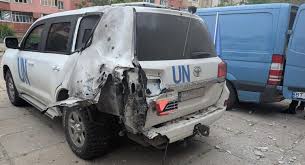
A United Nations vehicle participating in an inter-agency humanitarian mission in Ukraine came under attack despite prior notification being given to all involved parties. The mission was coordinated by the UN Office for the Coordination of Humanitarian Affairs (OCHA), highlighting growing concerns about the safety of humanitarian workers operating in conflict zones.
In an official statement, the UN Secretary-General stressed that international humanitarian law must always be upheld. The statement emphasized that civilians, humanitarian personnel, and relief-related infrastructure are protected under international law and should never be targeted during military operations.
The United Nations is currently investigating the incident to determine the full circumstances surrounding the attack.
Civilians Continue to Suffer in Ukraine
The incident occurred during one of the most intense waves of attacks since the beginning of Russia’s full-scale invasion of Ukraine. Overnight, Russian forces reportedly launched nearly 800 drones and 56 missiles, with Kyiv among the primary targets.
According to the UN Country Team in Ukraine, the assault lasted close to 24 hours and involved continuous ballistic and cruise missile strikes across several regions. The attacks caused widespread fear among civilians and added further pressure on already strained emergency and humanitarian services.
The UN warned that civilians continue to bear the heaviest burden of the conflict, with ongoing destruction affecting homes, infrastructure, healthcare systems, and humanitarian operations.
Humanitarian Crisis Deepens in South Sudan
Meanwhile, humanitarian agencies in South Sudan have expanded emergency assistance efforts following violent clashes in the Akobo region earlier this year. The violence displaced tens of thousands of residents, forcing many families to flee their homes in search of safety.
To respond to the growing crisis, the UN Humanitarian Air Service (UNHAS) carried out an emergency airdrop operation in Bora village, located in Jonglei state. The mission delivered more than 1,000 bags of cereals and pulses, enough to support approximately 3,000 people living in isolated communities with limited humanitarian access.
Many displaced families escaped to nearby villages such as Bilkey, Gagdong, Dengjok, and Nyandit, while others crossed into Ethiopia’s Gambella Region. Humanitarian facilities and storage centers were also damaged during the violence, disrupting aid operations and limiting access to food, healthcare, and basic necessities.
Health officials in Akobo reported a sharp rise in severe acute malnutrition cases, particularly among children. Local health facilities are struggling to manage the increasing number of patients suffering from hunger-related illnesses and medical complications.
Over the past several days, UNHAS has transported dozens of humanitarian workers and thousands of kilograms of emergency supplies into affected areas. Relief efforts currently include food distribution, nutrition screening, and medical assistance for vulnerable families returning from displacement.
UN Warns of Rising Pressure on LGBTIQ+ Rights
UN Secretary-General António Guterres has raised concerns over increasing attacks on the rights of LGBTIQ+ communities around the world. Speaking on the International Day Against Homophobia, Biphobia and Transphobia, observed annually on 17 May, he warned that progress toward equality is facing serious setbacks in many countries.
Mr. Guterres stated that discriminatory laws, hostile political rhetoric, and growing social intolerance are threatening the safety and dignity of millions of people. He noted that, for the first time in years, the number of countries criminalizing consensual same-sex relations has increased.
The UN High Commissioner for Human Rights, Volker Türk, also urged governments to repeal laws targeting same-sex relationships and strengthen protections against discrimination, violence, and online hate speech.
Progress and Challenges Around the World
Although some countries have made progress in advancing equality, significant challenges remain globally. Recent developments include the decriminalization of consensual same-sex relations in countries such as St. Lucia and Botswana, along with Nepal electing its first transgender woman parliamentarian.
At the same time, several nations continue to criminalize same-sex relations, with some still enforcing the death penalty. Human rights experts also warned about growing online harassment, political hostility, and reduced funding for civil society organizations that support vulnerable communities.
The UN emphasized that democracy and human rights depend on equal dignity, participation, and protection for all individuals regardless of sexual orientation or gender identity.
FAQS
What was the UN humanitarian mission in Ukraine?
The mission was an inter-agency humanitarian operation coordinated by OCHA to deliver humanitarian assistance and support civilians affected by the conflict in Ukraine.
Why did the UN condemn the attack?
The UN condemned the attack because humanitarian personnel and civilian objects are protected under international humanitarian law and should never be targeted during conflicts.
What caused the humanitarian crisis in South Sudan?
Violence in the Akobo region displaced thousands of families, damaged humanitarian facilities, and disrupted access to food, healthcare, and essential services.
What assistance is the UN providing in South Sudan?
The UN is delivering emergency food supplies, nutrition support, medical assistance, and transporting humanitarian workers to affected communities.
What concerns did the UN raise about LGBTIQ+ rights?
The UN warned that discrimination, restrictive laws, online hate, and hostile political rhetoric are increasing threats against LGBTIQ+ communities worldwide.
Which UN officials spoke about LGBTIQ+ rights?
UN Secretary-General António Guterres and UN High Commissioner for Human Rights Volker Türk both addressed growing concerns over discrimination and attacks on LGBTIQ+ rights globally.
Conclusion
The latest developments in Ukraine, South Sudan, and the global struggle for LGBTIQ+ rights reflect the growing humanitarian and human rights challenges facing the international community. From attacks on humanitarian missions and worsening displacement crises to increasing pressure on vulnerable communities, the United Nations continues to call for stronger protection of civilians, respect for international law, and equal rights for all people. As conflicts and social tensions continue worldwide, global cooperation and humanitarian support remain essential to protecting lives and preserving human dignity.
