

For years, PC gaming has been tied to desks, keyboards, and uncomfortable seating positions. While mouse-and-keyboard controls remain unmatched for precision, they often demand long hours hunched over a setup that feels more like a workstation than a place to relax. Valve’s latest Steam Controller aims to change that by bringing a more console-like experience to PC gaming without sacrificing the flexibility PC players expect.
Priced at around $100, the redesigned Steam Controller is built for players who want to enjoy strategy games, RPGs, and other traditionally keyboard-heavy genres from the comfort of a couch. It combines familiar controller elements with Valve’s signature trackpads, creating a device that feels both innovative and surprisingly practical. However, it is not a plug-and-play solution for everyone. Casual players may struggle with the amount of customization required, while enthusiasts willing to tweak settings will likely appreciate the controller’s versatility.
A More Familiar Design Than the Original
Valve’s original Steam Controller from 2015 divided gamers with its unusual design and oversized trackpads that replaced traditional thumbsticks entirely. The new version takes a far more conventional approach.
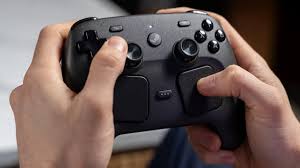
The updated controller resembles modern gamepads like the PS5 DualSense, complete with symmetrical analog sticks, face buttons, triggers, and a more ergonomic grip. While the dual square trackpads remain the defining feature, they no longer dominate the design. Instead, they work alongside the thumbsticks to provide additional precision and flexibility.
At first glance, the controller appears bulky, but in practice it feels lightweight and comfortable. Its dimensions are comparable to a standard PlayStation controller, though the placement of the trackpads shifts the thumbsticks slightly upward. Players with average or larger hands will likely adapt quickly, but those with smaller hands may find reaching certain controls uncomfortable during long sessions.
Weighing just under 300 grams, the controller avoids feeling overly heavy despite housing a large battery. Valve claims over 35 hours of battery life, and real-world use suggests that estimate is realistic. Long gaming sessions can easily stretch across several days without needing a recharge.
The Unique Trackpads Steal the Show
The Steam Controller’s biggest advantage is undoubtedly its dual trackpads. These pads function as either mouse replacements or alternative thumbstick inputs, allowing genres like RTS and CRPG games to feel playable on a controller for the first time.
Games such as Total War: Warhammer III, Crusader Kings III, and Baldur’s Gate III benefit greatly from the added precision. Instead of awkward radial menus or slow cursor movement, the trackpads provide fast navigation and smoother menu control.
The haptic feedback built into the pads is subtle but effective, helping players understand cursor movement without needing visual confirmation. However, physically clicking the trackpads can feel overly sensitive at times, occasionally causing accidental movements during precise selections.
For strategy and role-playing fans, these trackpads make the Steam Controller stand apart from traditional console controllers. They bridge the gap between mouse precision and couch gaming comfort better than most competing devices.
Customization Is Both the Best and Worst Feature
Valve has built the Steam Controller around deep customization. Nearly every button, trigger, and trackpad action can be adjusted through Steam’s controller software.
Players can:
- Change trigger actuation points
- Assign touch menus to trackpads
- Create custom hotkeys
- Adjust gyro sensitivity
- Remap entire control schemes
This level of freedom is incredibly powerful, especially for games that were never designed with controllers in mind. However, it also creates the controller’s biggest weakness.
Many games require extensive setup before they feel comfortable to play. Users often need to spend significant time tweaking layouts, testing configurations, and learning custom inputs. Community-made control schemes help simplify the process, but they rarely eliminate the need for personal adjustments.
For enthusiasts, this flexibility is exciting. For casual players, it may become frustrating quickly.
Excellent Joysticks With Modern Technology
Valve avoided one of the biggest problems affecting modern controllers: stick drift.
Instead of using traditional potentiometer-based joysticks, the Steam Controller uses advanced TMR (tunneling magnetoresistance) technology. Similar to Hall effect sticks, TMR sensors rely on magnetic fields rather than physical contact, making them far more resistant to wear over time.
The result is a joystick that feels accurate, responsive, and durable. The sticks offer satisfying resistance without feeling loose or flimsy, something many third-party Hall effect controllers struggle to achieve.
The rest of the controller’s buttons also feel solid and responsive:
- Face buttons deliver clean tactile feedback
- The D-pad minimizes accidental diagonal inputs
- Back buttons are easy to reach
- Triggers feel smooth and springy
One missing feature, however, is instant trigger locks. Competitive players who prefer shorter trigger travel for faster inputs may be disappointed that Valve relies solely on software customization instead of physical trigger stops.
Gyro Controls and Rumble Need Improvement
The Steam Controller includes gyro aiming support, allowing players to fine-tune their aim through motion controls. When properly configured, gyro aiming feels accurate and responsive, especially when combined with the trackpads.
Unfortunately, Valve’s “Grip Sense” activation system can feel inconsistent. The feature is supposed to activate gyro controls when the player adjusts their grip, but in practice it often struggles to detect movement reliably.
The controller’s rumble is also relatively restrained compared to competitors like the PS5 DualSense. While the feedback feels detailed and nuanced, some players may prefer stronger vibration effects for more immersive gameplay.
Built for Valve’s Future Hardware Vision
The Steam Controller is more than just a standalone accessory. It represents Valve’s larger ambition to make PC gaming feel as convenient as console gaming.
The controller is designed to work closely with Valve’s upcoming Steam Machine platform and future SteamOS devices. Features like the included wireless charging puck hint at a broader ecosystem where multiple controllers connect seamlessly to living-room hardware.
Still, the experience remains incomplete on standard Windows PCs. Tasks like adjusting audio settings or navigating Windows menus often require switching away from Steam’s Big Picture Mode and returning to a keyboard and mouse.
Valve’s vision becomes much more compelling when paired with a dedicated SteamOS-based device that supports instant sleep, wake functionality, and controller-native navigation.
Is the Steam Controller Worth Buying?
The Steam Controller is not trying to replace a keyboard and mouse completely. Instead, it offers a middle ground for players who want PC-level flexibility without being trapped at a desk.
For strategy gamers, RPG fans, and players who value comfort over competitive precision, the controller delivers a unique and rewarding experience. The trackpads, customizable controls, and advanced joysticks create possibilities few other controllers can match.
However, it demands patience. Players unwilling to spend time adjusting settings and learning custom layouts may find the experience frustrating.
Valve has created a controller aimed at dedicated PC enthusiasts who want freedom and flexibility. It may not be perfect, but it represents one of the boldest attempts yet to make PC gaming feel truly comfortable from the couch.
FAQS
What makes the Steam Controller different from other controllers?
The Steam Controller uses dual trackpads alongside traditional thumbsticks, allowing more precise control in PC games like strategy titles and RPGs.
Does the Steam Controller support all PC games?
Yes, but many games require custom control setups for the best experience. Some games offer native support, while others rely on user-created profiles.
Are the Steam Controller joysticks resistant to stick drift?
Yes. Valve uses TMR joystick technology, which is more durable and resistant to stick drift compared to traditional potentiometer-based sticks.
Is the Steam Controller good for casual gamers?
It depends. Casual players may find the extensive customization process frustrating, while enthusiasts will likely appreciate the flexibility.
How long does the battery last?
Valve claims the controller can deliver more than 35 hours of gameplay on a single charge, making it one of the longer-lasting wireless controllers available.
Can the Steam Controller replace a keyboard and mouse?
Not entirely. While it performs surprisingly well in many PC genres, a traditional keyboard and mouse setup still offers superior precision for competitive and complex tasks.
Does the controller work well for RPGs and RTS games?
Yes. The trackpads make menu navigation, camera movement, and cursor control much easier than standard controllers in games like Baldur’s Gate III and Total War.
Is the Steam Controller comfortable for long gaming sessions?
For most players, yes. Its lightweight build and ergonomic design make it comfortable for extended use, though users with smaller hands may struggle with the layout.
Conclusion
The Steam Controller succeeds where many PC accessories fail by prioritizing comfort without completely sacrificing precision. Its innovative trackpads, highly customizable controls, and drift-resistant TMR joysticks make it one of the most unique gaming controllers available today. Valve has clearly designed it for players who enjoy experimenting with control setups and want access to genres traditionally considered difficult on a controller.
At the same time, the learning curve cannot be ignored. Setting up controls for every game requires time, patience, and technical familiarity. Casual users looking for a simple plug-and-play experience may prefer more traditional controllers instead.
Still, for PC gamers who dream of enjoying deep RPGs and strategy games from the comfort of a couch, the Steam Controller comes remarkably close to delivering that ideal experience. It may not fully replace a keyboard and mouse, but it offers one of the most comfortable and flexible alternatives PC gaming has seen in years.
